
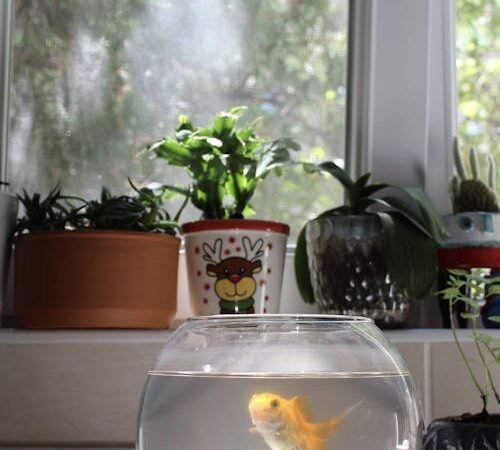
Overfeeding is one of the most common mistakes in home fishkeeping, and it almost always comes from the right place. The signs you are overfeeding your fish include uneaten food settling on the substrate, cloudy or foul-smelling water, persistent algae blooms, and rising ammonia levels on your test kit. If any of those sound familiar, you are not alone, and the fix is gentler than you might expect.
There is a particular look that fish have mastered. The moment a shadow passes over the tank, they rush to the surface. They press against the glass. They hover at the corner where the food usually falls, wide-eyed and insistent. It is hard to resist. It feels like hunger, and responding to hunger feels like care.
It took me longer than I care to admit to understand that my fish were not actually starving. They were simply doing what fish do.
Why Fish Always Look Hungry
Fish are built for scarcity. In the wild, a reliable meal is never guaranteed, so their instinct is to eat whenever food is present, regardless of whether they actually need it. That eager rush to the surface is not a cry for help. It is a deeply wired survival behavior that has nothing to do with how recently they last ate.
Most healthy aquarium fish can go several days without food and come through just fine. A fish that begs convincingly at every feeding is not an underfed fish. It is a fish doing exactly what its biology tells it to do. Once that clicks, the temptation to add just a little more starts to loosen its grip.
How to Tell If You’re Overfeeding Your Fish
The clearest sign is food that lingers. If flakes or pellets are still floating, drifting, or settling to the bottom more than two to three minutes after you feed, the portion is too large. Uneaten food breaks down quickly, feeding bacteria and pushing your water chemistry in the wrong direction.
Beyond visible food, watch for these signals in your tank:
Cloudy or milky water in an established tank often points to a bacterial bloom triggered by decomposing organic matter. A healthy, stable aquarium should be clear. If yours has gone hazy between water changes, excess food is a likely culprit.
A smell that does not belong is another clue. A well-maintained tank has almost no odor, or perhaps a faint earthy note. A sour or sulfurous smell suggests something is decaying below the surface, often food that has settled into substrate or tucked behind decorations and gone unnoticed.
Algae that will not quit is worth paying attention to. Some algae is normal, especially in a newer tank. But if you find yourself scrubbing the glass every few days and the problem keeps returning, excess nutrients from uneaten food may be fueling the growth. Our post on making peace with algae in a new aquarium covers this in more depth.
Elevated ammonia or nitrite readings on your test kit can also signal that your tank is processing more organic waste than it can handle. If you are not testing your water regularly, it is worth starting. Our guide on reading your aquarium water test kit walks through what each number means and when to take action.
What Overfeeding Does to Your Aquarium Water
Every uneaten flake that sinks to the substrate begins to decompose. That decomposition releases ammonia, which puts pressure on the beneficial bacteria in your filter. If the waste load is consistently higher than what the bacterial colony can process, ammonia and nitrite levels can climb, and both are harmful to fish even in small amounts.
Over time, chronic overfeeding creates a cycle that is hard to break. High nutrients feed algae and bacteria. The water becomes harder to manage. Filters clog more frequently. Fish that seemed fine begin to show stress. The good news is that pulling back on food is one of the most immediate things you can do to shift the balance. Paired with a consistent water change routine, most tanks recover quite quickly once feeding is brought back in line.
Finding the Right Feeding Rhythm
A useful rule of thumb is to offer only what your fish can finish in two to three minutes, once or twice a day. For most community tanks, that is a surprisingly small amount. A pinch of flakes, a few pellets, nothing more. It is almost always less than what feels natural when you are standing there watching them beg.
Some fishkeepers find it helpful to skip one feeding day per week, often called a “fast day.” This is not harmful to healthy fish. It gives the tank a chance to catch up on any accumulated waste and can actually improve water quality noticeably by the following water change. Fish handle it without complaint, despite what their performance at the glass might suggest.
Bottom-dwelling fish and nocturnal species are worth thinking about separately. They may not compete at the surface during feeding time, so their food needs to reach them. Sinking pellets or wafers dropped in the evening, after the lights dim and more active tank mates have settled, ensure they are eating without requiring you to add extra food for everyone.
Tools That Help Keep Portions Honest
One of the most practical things for consistent, portion-controlled feeding is an automatic feeder. We have been using the EHEIM Everyday Automatic Fish Feeder for a while now, and it has taken a lot of guesswork out of mealtimes. You set the amount and the schedule, and it dispenses the same portion every time without the temptation to add a little extra. It has been particularly useful on days when more than one person in the household might otherwise feed the tank without realizing someone else already did.
Quality food also matters more than it might seem. A nutritionally complete flake food like TetraMin Tropical Flakes is formulated to give fish what they need in smaller amounts. The flakes are designed to break down cleanly and leave less residue than cheaper alternatives, which helps with water clarity between changes. When the food is doing its job well, there is less pressure to add more just to make sure the fish are getting enough.
Common Questions
How can I tell if my fish are actually underfed rather than just acting hungry?
Genuinely underfed fish tend to look visibly thinner over time, with a slightly pinched belly or a concave appearance just behind the head. Their colors may fade and activity levels often drop. If your fish look round and energetic but beg relentlessly, they are almost certainly not underfed. The begging behavior is instinctive and not a reliable indicator of hunger in fish that are otherwise healthy.
Is it safe to skip a feeding entirely?
Yes, for most healthy adult fish, skipping one feeding per week is completely safe and is actually a practice many experienced fishkeepers follow. It gives the tank a chance to process any accumulated waste and can improve water quality by the next water change. Very young fish, fry, or fish recovering from illness are exceptions and should be fed more consistently. When in doubt, a short fast is far less risky than a little extra food.
What should I do if I’ve been overfeeding for a while and the water quality has suffered?
Start with a partial water change of around 25 to 30 percent, then reduce feeding to once daily with very small amounts for a week or two. Check for uneaten food after each feeding and remove any with a turkey baster or small net before it has a chance to break down. Test your water every few days during this period to track whether ammonia and nitrite are returning to zero. Most tanks stabilize within one to two weeks once the source of excess nutrients is addressed.
There is something quietly reassuring about the moment you realize your fish are not actually suffering when you hold back. They are fine. They are healthy. They will still rush the surface tomorrow, and the day after that, and every day for as long as you share that tank with them. The eagerness is just part of who they are. Feeding a little less is not withholding love. It is offering something closer to it.
Leave a Reply
You must be logged in to post a comment.